

BLUF
Getting an Authority to Operate is a milestone. It is not the finish line. In federal systems, the real risk often begins after authorization, when programs face vulnerability backlogs, control drift, weak documentation, inconsistent patching, and poor continuous monitoring. Programs do not usually fail because they never achieved an ATO. They fail because they treat the ATO as a one-time event instead of a living security obligation. That is why long-term sustainment matters more than initial authorization.
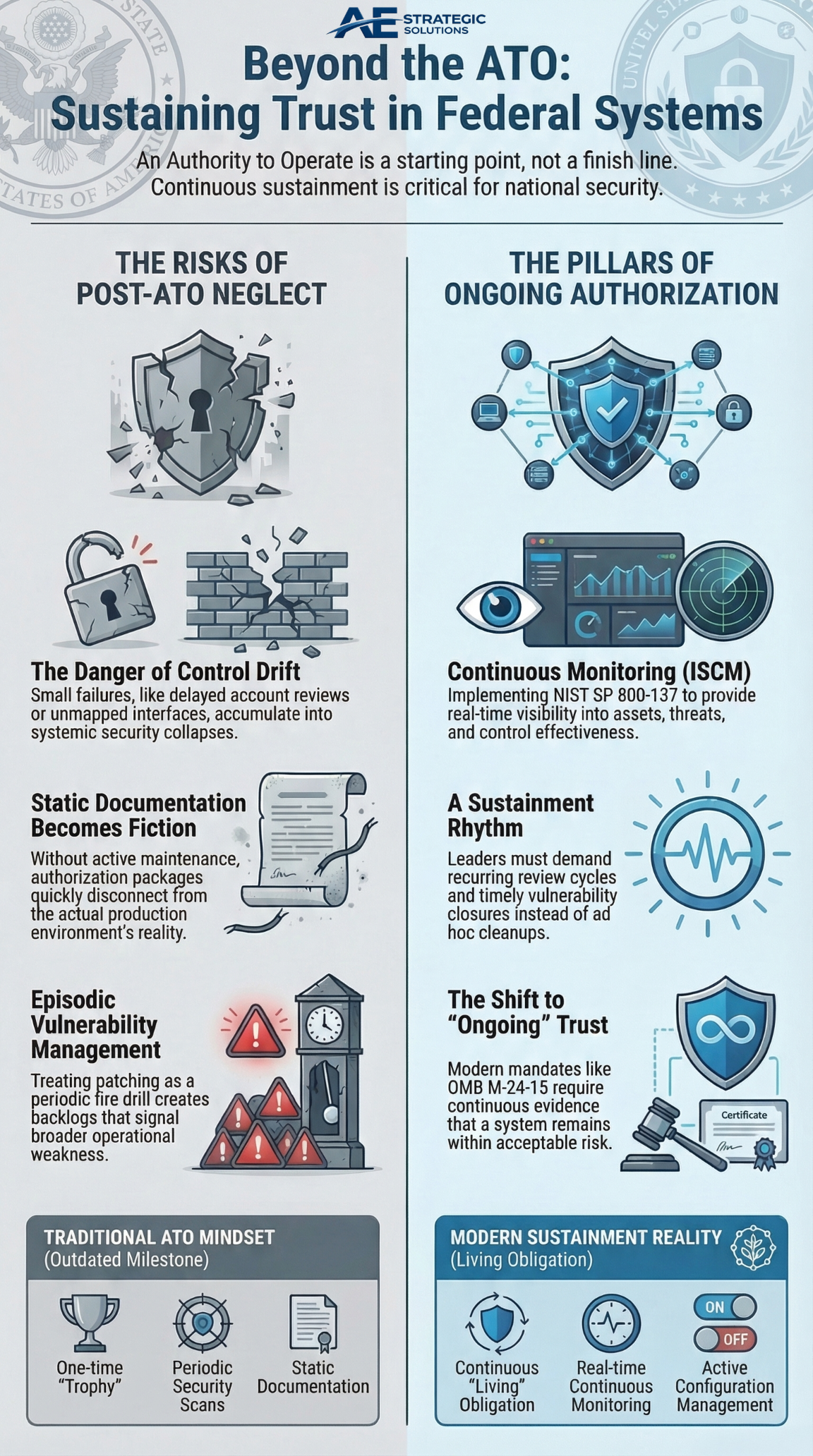
Table of Contents
- Why the ATO misconception is dangerous
- Authorization is the beginning, not the end
- Control drift is where many programs start slipping
- Vulnerability management cannot be episodic
- Continuous monitoring is the real proof of trust
- Documentation discipline separates stable programs from fragile ones
- Ongoing authorization reflects modern federal reality
- What leaders should demand after ATO
- Why this matters for AE Strategic Solutions
- Summary
- References
Why the ATO misconception is dangerous
Too many organizations still treat an ATO as a trophy. I see it differently. An ATO proves that, at a point in time, the system met an acceptable security threshold based on the facts, controls, documentation, and risk decisions available at that time. What it does not prove is that the system will remain secure six months later, after software changes, staff turnover, new integrations, inherited risk, unpatched vulnerabilities, and shifting mission requirements accumulate. NIST’s Risk Management Framework is explicit that authorization sits within a broader lifecycle approach that includes continuous monitoring. It is not designed to be a static approval that lives untouched after day one.
That misunderstanding creates a pattern I have seen repeatedly in federal environments. Teams push hard to get through assessment, package reviews, and decision briefings. Then, once the ATO lands, the energy drops. Security artifacts age. Findings remain open too long. Configuration baselines drift. Monitoring becomes reactive. The program assumes it is safe because it was once approved. That is often where the real trouble starts.
Authorization is the beginning, not the end
NIST SP 800-37 Rev. 2 describes the RMF as a disciplined process that includes categorization, control selection, implementation, assessment, authorization, and continuous monitoring. That structure alone makes the point: authorization is one step inside an ongoing process, not the final state. NIST also notes that continuous monitoring helps achieve ongoing authorization. That language matters because it shifts the focus from one-time approval to sustained evidence that risk remains understood and managed over time.
For federal leaders, this is the practical takeaway. The initial ATO tells you whether the system was ready to operate. Sustainment tells you whether it still deserves trust. Those are not the same thing. A system can pass assessment, receive authorization, and still degrade later through unmanaged change, control failures, or operational neglect.
Control drift is where many programs start slipping
Controls rarely fail all at once
Most programs do not collapse because every control stops working at once. They slip gradually. A technical setting changes. An account review is delayed. A new interface appears without full security review. A scanner runs, but the findings are not conclusive. A legacy exception stays open too long. These small failures build over time.
NIST’s continuous monitoring guidance explains that organizations need visibility into assets, threats, vulnerabilities, and the effectiveness of deployed controls. That is important because control failure is often not dramatic at first. It shows up as declining visibility, delayed corrective action, and a widening gap between what the security package says and what the system actually looks like in production.
ATO packages can become fiction if they are not maintained
This is one of the hardest truths in federal compliance. A well-built authorization package can become outdated fast if the team does not actively maintain it. Architecture changes, inventory shifts, interconnections evolve, and implementation details move. If the documentation does not track those changes, leadership makes risk decisions based on stale information. That undermines the value of the original ATO.
Vulnerability management cannot be episodic
One of the most common post-ATO failures is treating vulnerability management as a periodic fire drill instead of a sustained operational discipline. Vulnerability management is not only about running tools. It is about identifying issues, prioritizing risks, patching or mitigating in a timely manner, validating fixes, and documenting decisions. NIST’s vulnerability management resources tie this work directly to patch management, configuration management, and incident response. In other words, unresolved vulnerabilities are rarely isolated problems. They often signal broader operational weakness.
Patch discipline is especially important because federal systems change continuously. Software updates, third-party components, configuration changes, and emergency fixes all affect security posture. NIST highlighted software update and patch risk again in 2025 when it revised its control catalog to improve how organizations manage risks related to software updates and patches. That shows how central sustainment has become to real security performance.
Continuous monitoring is the real proof of trust
NIST SP 800 137 says the purpose of continuous monitoring is to provide visibility into assets, threats, vulnerabilities, and control effectiveness so leaders can make risk-based decisions. That is the practical core of ATO sustainment. A program does not remain trustworthy because it says the right things in a package. It remains trustworthy because it produces timely evidence that the system is still operating within acceptable risk.
This is also where many programs get exposed. They may have dashboards, scans, and reports, but not a real monitoring strategy tied to mission risk. Data collection alone is not enough. NIST’s guidance emphasizes preestablished metrics, regular analysis, and frequencies sufficient to support decision making. If monitoring is inconsistent, disconnected from leadership, or not tied to corrective action, then the program is collecting signals without actually sustaining trust.
Documentation discipline separates stable programs from fragile ones
Good sustainment is visible in documentation. If a system owner cannot produce updated plans, accurate inventories, current risk information, open item status, recent assessment evidence, and records of change, the program is probably weaker than it appears. Documentation is not bureaucracy for its own sake. It is how federal programs preserve accountability, continuity, and defensible decision-making across personnel changes, reassessments, audits, and incidents.
This matters even more in complex environments where multiple teams share responsibility. Without documentation discipline, the authorization package slowly disconnects from operations. Once that happens, it becomes harder to know what controls are truly inherited, what findings remain unresolved, and what risk the Authorizing Official is actually carrying forward.
Ongoing authorization reflects modern federal reality
Federal policy and practice are moving more openly toward ongoing authorization models. FedRAMP’s current materials emphasize continuous monitoring, ongoing authorization reporting, and updated processes to reflect modern expectations for cloud services. FedRAMP’s 20x documentation states that continuous monitoring, regular reporting, and ongoing authorization are required to maintain authorization. Its Phase Two materials also focus on how providers maintain ongoing authorization data that continuously demonstrates security posture. That is a major signal for the broader federal market. The direction is clear: trust must be maintained, not assumed.
OMB Memorandum M-24-15 also pushed GSA to update FedRAMP continuous monitoring processes and documentation to reflect the memo’s principles. That shows federal leadership is not treating sustainment as secondary work. It is central to the evolution of security assurance.
What leaders should demand after ATO
A real sustainment rhythm
Leaders should expect recurring review cycles, not ad hoc cleanup ahead of the next assessment. Sustainment must have cadence.
Timely vulnerability closure
Open findings need deadlines, ownership, validation, and escalation. Backlogs are not harmless. They are risk accumulation.
Monitoring tied to action
Dashboards alone do not protect systems. Monitoring should drive decisions, remediation, and leadership awareness.
Updated documentation
Every meaningful system change should be reflected in the package and supporting records before drift becomes systemic.
Leadership visibility into residual risk
Authorizing officials and program leaders need current, usable information. Sustainment only works when leadership sees risk clearly and early.
Why this matters for AE Strategic Solutions
This is exactly where AE Strategic Solutions can show value as a serious federal cybersecurity partner. Many firms know how to help a program chase initial authorization. Fewer know how to help it stay secure and defensible once the hard daily work begins. Sustainment demands responsiveness, documentation discipline, vulnerability management maturity, continuous monitoring awareness, and an understanding of how federal systems actually drift over time.
That is where credibility is earned. Not in saying a system got authorized once, but in helping leadership maintain confidence month after month as the environment changes. For primes and agencies alike, that is often the difference between paper compliance and operational trust.
Summary
An initial ATO matters, but it is only a starting point. The systems that remain trusted are the ones that sustain control effectiveness, close vulnerabilities, document change, and maintain continuous monitoring discipline over time. Federal programs usually do not break at the moment of authorization. They break later, when teams stop treating authorization as a living obligation. That is why ATO sustainment matters more than initial authorization.
References
- Federal Risk and Authorization Management Program. (2025, May 30). 20x Phase 1 (Archive). https://www.fedramp.gov/docs/20x/phase1/intro/
- Federal Risk and Authorization Management Program. (2026, January 13). RFC 0020 FedRAMP authorization designations. https://www.fedramp.gov/rfcs/0020/
- Federal Risk and Authorization Management Program. (2026). FedRAMP 20x Phase Two. https://www.fedramp.gov/20x/phase-two/
- Federal Risk and Authorization Management Program. (2026). M 24 15 Section IX. Implementation. https://fedramp.gov/docs/authority/m-24-15/implementation/
- Federal Risk and Authorization Management Program. (2026). Collaborative continuous monitoring. https://fedramp.gov/docs/20x/collaborative-continuous-monitoring/
- National Institute of Standards and Technology. (2011). Information security continuous monitoring (ISCM) for federal information systems and organizations (SP 800 137). U.S. Department of Commerce. https://csrc.nist.gov/pubs/sp/800/137/final
- National Institute of Standards and Technology. (2020). Assessing information security continuous monitoring (ISCM) programs: Developing an ISCM program assessment (SP 800 137A). U.S. Department of Commerce. https://csrc.nist.gov/pubs/sp/800/137/a/final
- National Institute of Standards and Technology. (2018). Risk management framework for information systems and organizations: A system life cycle approach for security and privacy (SP 800 37 Rev. 2). U.S. Department of Commerce. https://csrc.nist.gov/pubs/sp/800/37/r2/final
- National Institute of Standards and Technology. (2025, August 27). NIST revises security and privacy control catalog to improve software update risk management. https://www.nist.gov/news-events/news/2025/08/nist-revises-security-and-privacy-control-catalog-improve-software-update
- National Institute of Standards and Technology. (2026). Vulnerability management. https://csrc.nist.gov/topics/security-and-privacy/risk-management/vulnerabilities/vulnerability-management