

BLUF
If you are a prime contractor choosing a cybersecurity subcontractor, do not start with price. Start with mission trust. You need a partner who brings cleared talent, moves fast, understands federal contract realities, protects CUI with discipline, and fits into your program without creating drag, risk, or noise. The best subcontractor helps you win, perform, and stay compliant when the work gets difficult.
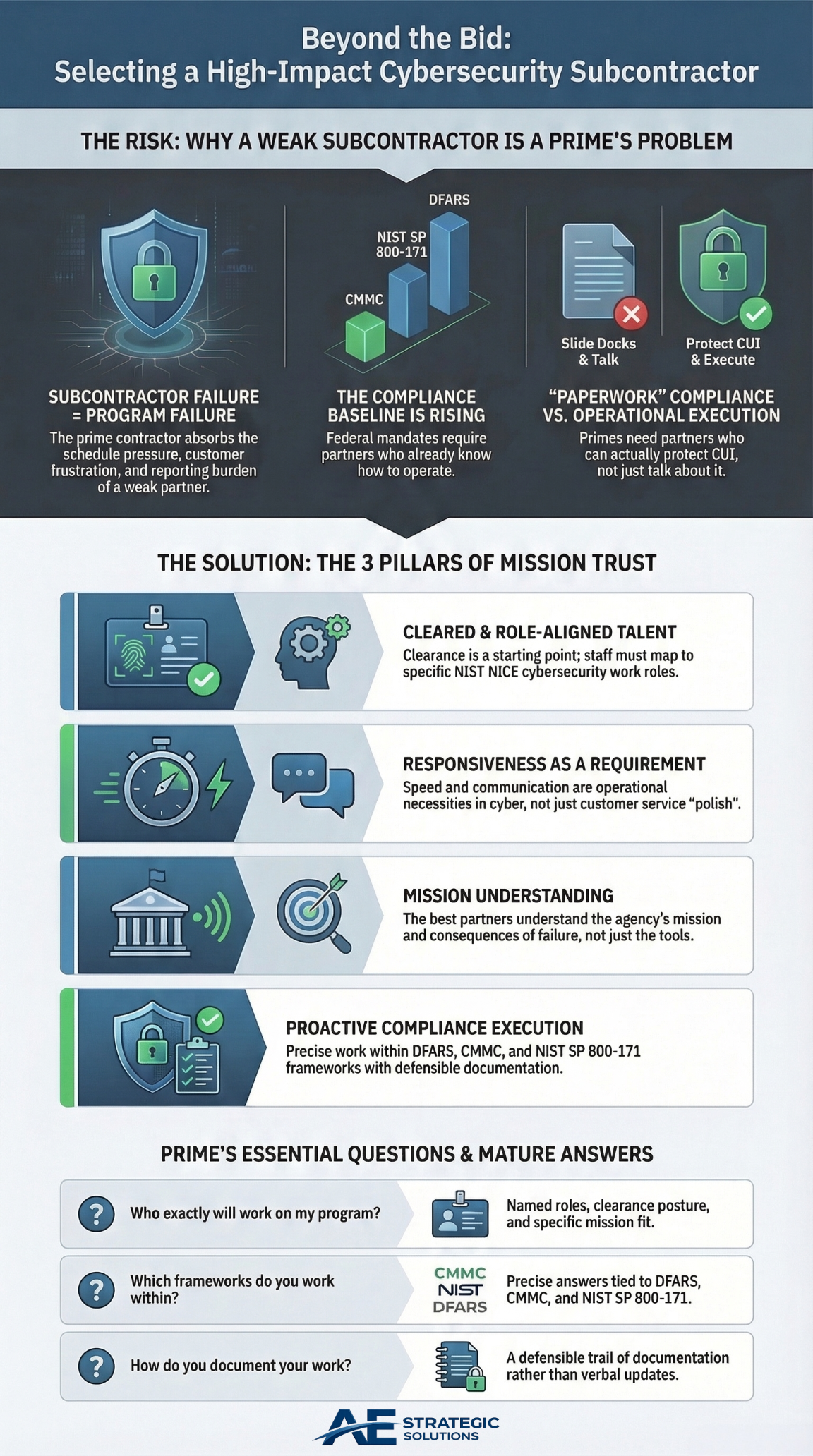
Table of Contents
- Why the wrong cyber subcontractor becomes a prime contractor problem
- Cleared talent matters more than résumé volume
- Responsiveness is a performance requirement
- Compliance depth separates real partners from slide decks
- Mission understanding changes everything
- What prime contractors should ask before signing
- Why AE Strategic Solutions is built for this role
- Summary
- References
Why the wrong cyber subcontractor becomes a prime contractor problem
I founded AE Strategic Solutions with a simple view of the market. Prime contractors do not need another company that talks well in capability statements but struggles inside real mission environments. They need a cybersecurity teammate who can step into federal work, understand the stakes, and execute with discipline.
When a subcontractor misses deadlines, mishandles sensitive data, overstates staff capabilities, or treats compliance like paperwork, the prime bears the brunt. The prime absorbs the schedule pressure, the customer frustration, the reporting burden, and the reputational damage. In federal and defense work, a weak cyber subcontractor does not stay a subcontractor problem for long. It becomes a program problem.
That matters even more now because the compliance baseline is not getting easier. The Department of Defense CMMC program exists to ensure defense contractors protect Federal Contract Information and Controlled Unclassified Information on contractor systems, and the rule is built around a consistent assessment of required cybersecurity practices. NIST SP 800 171 Rev. 3 also remains central to safeguarding CUI in nonfederal systems and organizations. In plain terms, primes need partners who already know how to operate in this environment.
Cleared talent matters more than résumé volume
Clearances are not a bonus feature
One of the first things I would tell any prime contractor is this: do not confuse headcount with mission readiness. A large bench means little if the people cannot access the environment, understand the customer, or operate within the security boundaries of the contract.
In many federal missions, cleared talent is not a nice-to-have. It is the starting point. You need people who can enter sensitive environments, protect information, communicate professionally with government stakeholders, and contribute without slowing the team down. A subcontractor with access-ready personnel can reduce onboarding friction, support continuity, and help the prime meet mission demands faster.
Capability should align with real cyber work roles
Talent quality also means role clarity. NIST’s NICE Framework exists to give employers and government a common language for cybersecurity work, including the knowledge and skills needed for specific cyber functions. Prime contractors should look for subcontractors who can explain exactly what their people do, how they fit the mission, and where they add value, rather than hiding behind vague labels like analyst, engineer, or cyber expert.
At AE Strategic Solutions, I believe primes should expect a subcontractor to answer four talent questions clearly:
Do you have the right clearances?
A serious partner should tell you the proposed team’s clearance posture and whether those people are already positioned for the work.
Do your people match the mission?
A capable firm should map staff to actual functions such as risk management, security operations, compliance support, incident response, architecture, engineering, or program support.
Can your people work inside government culture?
Technical skill matters. Mission maturity matters too. The best cyber professionals know how to communicate, document, escalate, and support the chain of accountability.
Can you scale without collapsing quality?
A partner should be able to support a surge without flooding a program with unvetted labor.
Responsiveness is a performance requirement
Slow response creates program risk
In cybersecurity, responsiveness is not customer service polish. It is an operational requirement. Prime contractors need subcontractors who respond quickly, adapt quickly, and surface risks early. Waiting too long to flag an issue, produce a deliverable, or respond to an emerging event can create schedule slips and contract friction.
NIST’s most current incident response guidance emphasizes preparation, coordinated response, and improved detection, response, and recovery efficiency across cyber risk management activities. That matters to primes because it reinforces a broader truth: speed, structure, and communication are not optional in cyber operations.
Responsiveness shows up in everyday execution
Prime contractors should look for signs of responsiveness before award and after kickoff.
During capture and teaming
- Does the subcontractor return edits quickly?
- Do they turn comments into action?
- Do they understand proposal pressure and color team cycles?
- Do they make your life easier or harder?
During execution
- Do they communicate risk early?
- Do they document decisions clearly?
- Do they meet internal deadlines without excuses?
- Do they respond like owners of the mission?
I have seen too many firms promise responsiveness and then disappear into internal churn. That approach does not work in federal cybersecurity. Prime contractors need teammates who move with discipline and stay visible.
Compliance depth separates real partners from slide decks
Compliance is operational, not decorative
Any subcontractor can say they understand compliance. The real question is whether they can operate inside it. Prime contractors should look for partners who understand the difference between claiming familiarity and demonstrating execution.
For defense work, that starts with knowing how core requirements connect. DFARS 252.204 7012 requires safeguarding covered defense information and cyber incident reporting. DFARS 252.204 7020 addresses NIST SP 800 171 DoD assessment requirements. CMMC provides the assessment structure designed to verify implementation of required practices for protecting FCI and CUI. NIST SP 800 171 Rev. 3 provides the underlying security requirements for protecting CUI in nonfederal systems.
A serious cybersecurity subcontractor should be able to discuss these requirements in plain language. They should know what they mean for system boundaries, documentation, incident reporting, access control, audit logging, personnel practices, and operational accountability.
Primes should look for evidence of compliance maturity
Here is what I believe primes should test for.
Understanding of CUI handling
The partner should understand where CUI lives, who touches it, how it is protected, and how to support compliant workflows around it.
Familiarity with governance and risk
NIST CSF 2.0 placed greater emphasis on governance through the Governance function. That matters because primes need subcontractors who see cybersecurity as both a business and a mission risk, not just a tool issue.
Incident reporting discipline
A subcontractor should understand reporting obligations, escalation paths, and the need to provide incident report numbers to the prime when required under DFARS.
Documentation culture
If a firm cannot produce clear documentation, it will struggle in federal cyber environments. Good documentation supports trust, assessments, continuity, and defensible program management.
Compliance depth protects the prime’s brand
The prime contractor’s customer will rarely care that a subcontractor was the weak link. They will care that the program failed to perform. That is why compliance depth matters. It protects delivery, reputation, recompete chances, and customer trust.
Mission understanding changes everything
Technical skill without mission context is incomplete
I tell people this often: cybersecurity in the federal space is not abstract. It exists to support a mission. The subcontractor who understands the mission will always outperform the one who only understands the tool set.
Mission understanding means knowing the environment, the user, the pace, and the consequences of failure. It means understanding that federal customers do not buy cyber for cyber’s sake. They buy resilience, readiness, continuity, risk reduction, and confidence.
A good teaming partner should understand how cybersecurity supports operational outcomes. That includes protecting sensitive data, maintaining system availability, enabling secure modernization, and supporting the government’s broader risk management goals reflected in frameworks like CSF 2.0.
Primes should ask whether the subcontractor understands these realities
Does the firm understand the pressure to perform under contract?
Federal programs move through reviews, milestones, reporting cycles, option years, staffing changes, and customer scrutiny. The subcontractor should be able to function inside that reality.
Does the firm understand the agency mission?
A partner should understand who the end user is, what the mission depends on, and how cyber failures could affect operations.
Does the firm support the prime’s reputation?
The best subcontractors strengthen the prime’s standing with the customer. They do not create avoidable noise.
What prime contractors should ask before signing
1. Who exactly will work on my program?
Do not accept a generic bench answer. Ask for named roles, likely labor alignment, clearance posture, and mission fit.
2. What federal compliance frameworks do you actively work within?
Listen for precise answers tied to DFARS, CMMC, NIST SP 800 171, incident response obligations, and risk governance.
3. How do you handle time sensitive issues?
A capable firm should explain escalation, communication rhythm, decision paths, and reporting discipline.
4. How do you protect my customer relationship?
The answer should reflect professionalism, discretion, accountability, and an understanding that the prime owns the contract relationship.
5. How do you document your work?
Good cyber support leaves a defensible trail. Weak firms rely on memory and verbal updates.
6. How do you align technical work to mission outcomes?
If the answer stays stuck at the tool level, the firm may not understand federal execution.
Why AE Strategic Solutions is built for this role
I built AE Strategic Solutions around the needs that prime contractors actually face. They need a partner they can trust in front of the customer, behind the firewall, and inside the compliance environment.
That means bringing the kind of cleared and mission-ready talent that can contribute from day one. It means responding with urgency and discipline. It means understanding the rules that govern federal cybersecurity work and respecting the operational reality behind those rules. It also means understanding that our role as a subcontractor is not to create friction. Our role is to help the prime perform, protect the mission, and strengthen confidence across the team.
Prime contractors should demand more from cybersecurity subcontractors. They should expect maturity, speed, clarity, and mission alignment. That is the standard I believe in, and that is the standard AE Strategic Solutions is built to meet.
Summary
The right cybersecurity subcontractor does more than fill a labor category. The right partner reduces risk for the prime, supports mission performance, strengthens compliance posture, and earns trust through disciplined execution. When primes evaluate cyber partners through the lenses of cleared talent, responsiveness, compliance depth, and mission understanding, they make better teaming decisions and build stronger programs. From my perspective, that is exactly where AE Strategic Solutions belongs.
References
- National Institute of Standards and Technology. (2020). Workforce framework for cybersecurity (NICE Framework) (NIST Special Publication 800 181 Rev. 1). U.S. Department of Commerce. https://csrc.nist.gov/pubs/sp/800/181/r1/final
- National Institute of Standards and Technology. (2024, February 26). The NIST Cybersecurity Framework (CSF) 2.0 (NIST CSWP 29). U.S. Department of Commerce. https://www.nist.gov/publications/nist-cybersecurity-framework-csf-20
- National Institute of Standards and Technology. (2024, May 14). NIST issues updated security requirements for protecting CUI. https://csrc.nist.gov/news/2024/updated-security-requirements-for-protecting-cui
- National Institute of Standards and Technology. (2024). Protecting controlled unclassified information in nonfederal systems and organizations (NIST Special Publication 800 171 Rev. 3). U.S. Department of Commerce. https://csrc.nist.gov/pubs/sp/800/171/r3/final
- National Institute of Standards and Technology. (2025). Incident response recommendations and considerations for cyber risk management (NIST Special Publication 800 61 Rev. 3). U.S. Department of Commerce. https://csrc.nist.gov/pubs/sp/800/61/r3/final
- U.S. Department of Defense. (n.d.). 32 CFR Part 170, Cybersecurity Maturity Model Certification (CMMC) Program. Electronic Code of Federal Regulations. https://www.ecfr.gov/current/title-32/subtitle-A/chapter-I/subchapter-G/part-170
- U.S. Department of Defense. (n.d.). DFARS 204.7302, Policy. Acquisition.gov. https://www.acquisition.gov/dfars/204.7302-policy
- U.S. Department of Defense. (n.d.). DFARS 252.204 7012, Safeguarding covered defense information and cyber incident reporting. Acquisition.gov. https://www.acquisition.gov/dfars/252.204-7012-safeguarding-covered-defense-information-and-cyber-incident-reporting
- U.S. Department of Defense. (n.d.). DFARS 252.204 7020, NIST SP 800 171 DoD assessment requirements. Acquisition.gov. https://www.acquisition.gov/dfars/252.204-7020-nist-sp-800-171dod-assessment-requirements