

BLUF
Federal supply chain risk does not begin when a system fails. It begins much earlier, when a program accepts technology it does not fully understand, cannot fully trace, or has not fully verified. That risk grows when agencies and contractors rely on third-party software, embedded components, independent distributors, brokers, and Gray Market Material that moves through unofficial or unintended channels. NIST says supply chain risk includes products and services that may contain malicious functionality, be counterfeit, or be vulnerable because of poor manufacturing and development practices. Federal rules now also allow exclusion and removal orders for covered articles, including hardware, devices, software, cloud services, and products with embedded IT. In plain terms, the federal supply chain is now a cyber battlefield, not just a procurement process.
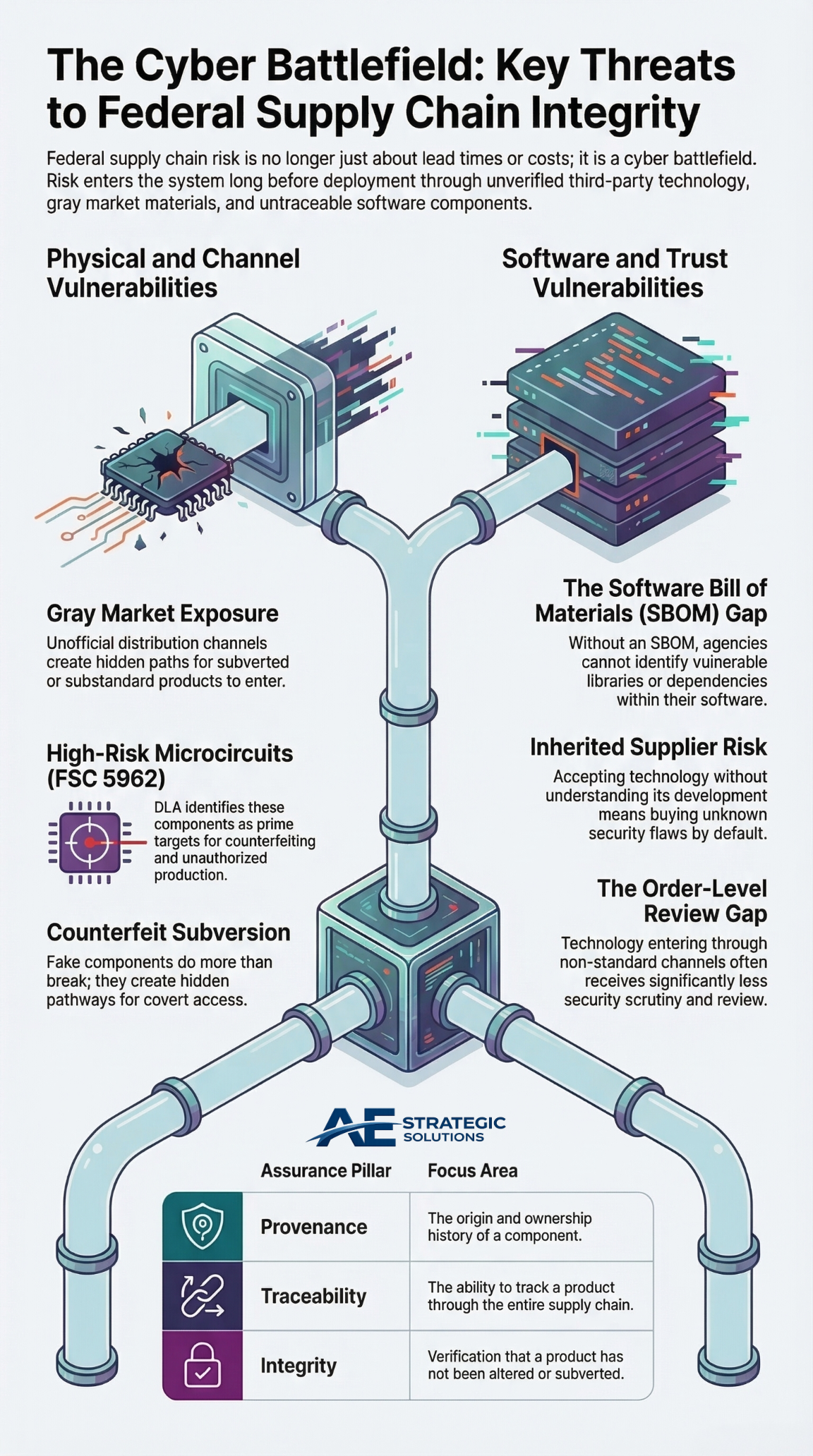
Table of Contents
- Why federal supply chain risk is now a cyber issue
- Third-party technology is a trust problem before it becomes a technical problem
- Gray Market Material creates a hidden path for cyber exposure
- Counterfeit and subverted components do more than break hardware
- Software supply chains can create just as much risk as physical products
- Why chain of custody, traceability, and provenance matter
- What prime contractors and federal buyers should do now
- Why this matters for AE Strategic Solutions
- Summary
- References
Why federal supply chain risk is now a cyber issue
I see too many organizations talk about supply chains as if they are only a sourcing or logistics topic. That mindset is outdated. The federal government now treats supply chain integrity as a cybersecurity issue because risk can enter long before deployment, often through the products, services, and suppliers a program trusts by default. NIST’s current supply chain guidance states that organizations face risk from products and services that may contain malicious functionality, may be counterfeit, or may be vulnerable due to poor manufacturing and development practices. It also warns that these risks are tied to reduced visibility into how technology is developed, integrated, and deployed.
That shift matters because federal systems no longer rely on a single vendor or a single controlled environment. They depend on software components, cloud services, embedded firmware, external support providers, third-party platforms, and supply channels that span multiple jurisdictions and commercial intermediaries. FAR 52.204 30 reflects that broader reality. It defines covered articles to include IT, cloud computing services, telecommunications equipment and services, hardware, systems, devices, software, and services that include embedded or incidental IT.
Third-party technology is a trust problem before it becomes a technical problem
Every federal buyer eventually depends on third-party technology. The real question is whether that dependency is governed or merely assumed. NIST SP 800 218 says software purchasers and consumers can use the Secure Software Development Framework to improve communication with suppliers during acquisition and management activities, which is another way of saying buyers have to ask harder questions before they inherit supplier risk.
That is the issue I would emphasize to any prime contractor or federal program leader. If you do not know how a tool was built, what components sit inside it, who touched it, how updates are delivered, and whether the supplier follows secure development practices, then you are not buying certainty. You are buying unknowns. EO 14028 pushed this issue into the center of federal cyber policy, and NIST’s SBOM guidance explains why. An SBOM is a formal record of the components used to build software, and NIST says SBOMs improve transparency, provenance, and the speed at which vulnerabilities can be identified and remediated by federal departments and agencies.
Gray Market Material creates a hidden path for cyber exposure
Gray Market Material deserves more attention than it gets. It often sounds like a quality control problem. It is bigger than that. CISA’s gray market fact sheets describe gray market channels as unofficial, unauthorized, or unintended distribution paths that make origin tracing harder and can affect national supply chains. The Office of the Director of National Intelligence’s National Counterintelligence and Security Center also explains that acquiring ICT products from independent distributors, brokers, and the gray market increases the risk of encountering substandard, subverted, and counterfeit products. It defines the gray market as trade through channels that are legal but unofficial, unauthorized, or unintended by the original component manufacturer.
That matters in federal environments because Gray Market Material can appear legitimate on the surface while harboring hidden risk beneath. A component sourced outside authorized channels may have weaker provenance, weaker handling controls, weaker storage security, or no reliable assurance that the item has not been altered, substituted, repackaged, or mixed with counterfeit stock. NCSC warns that insecure delivery and storage mechanisms can expose products to unauthorized modification, substitution, diversion, malware insertion, and counterfeit hardware or software.
This is where many programs get trapped. Legacy sustainment demands speed. Obsolete parts are hard to find. Field requirements create urgency. Brokers promise availability. The gray market appears to solve the operational problem. In reality, it often shifts that problem into a supply chain assurance problem with cyber consequences.
Counterfeit and subverted components do more than break hardware
Counterfeit parts are often discussed in terms of failure rates, reliability, or maintenance cost. That is only part of the story. NIST’s supply chain project explicitly lists counterfeits, unauthorized production, tampering, theft, and the insertion of malicious software and hardware as examples of cyber supply chain risk.
The Defense Logistics Agency takes this seriously enough to maintain a Counterfeit Detection and Avoidance Program and to require added traceability documentation for high-risk microcircuits in Federal Supply Class 5962. DLA states that FSC 5962 items are high risk for counterfeiting and that vendors must provide traceability documentation or test reports before shipment. That is not abstract policy language. It is direct recognition that the wrong part in the wrong system can compromise mission assurance.
From a cybersecurity perspective, counterfeit and subverted components are dangerous because they can create hidden pathways for malfunction, covert access, unreliable output, or embedded compromise. Even when the issue is not overtly malicious, a suspect component can still degrade system trust, distort diagnostics, slow response times, and create uncertainty in operational environments where confidence matters.
Software supply chains can create just as much risk as physical products
Many buyers still think supply chain risk means chips, boards, and devices. That view is incomplete. Software supply chains now carry equal weight because software is assembled from components, dependencies, libraries, update mechanisms, external services, and development pipelines that may be outside the direct control of the acquiring agency. NIST SP 800-218 states that secure software development practices should be built into the SDLC to reduce vulnerabilities, mitigate exploitation, and address the root causes of defects.
NIST’s SBOM guidance reinforces the same point. If agencies do not know what is inside a software product, they will struggle to quickly identify vulnerable components when a flaw or third-party dependency issue arises. NIST says SBOMs provide transparency and provenance and can help indicate whether a developer or supplier is using secure software development practices.
That is why third-party technology must be evaluated as a living supply chain, not just a finished deliverable. The risk is not only what the vendor shipped. The risk also lies in how the product is maintained, patched, updated, integrated, and supported over time.
Why chain of custody, traceability, and provenance matter
I would frame this simply. If you cannot trace it, you should not trust it.
Federal procurement and supply chain security are moving in that direction. GSA says MAS contractors must certify the country of origin for products subject to the Trade Agreements Act, and it states that GSA performs upfront compliance screenings, ongoing monitoring, and uses supply chain illumination tools to identify and remove prohibited or high-risk products and suppliers. GSA also warns that order-level materials are not awarded under the MAS contract and have not been reviewed or approved by the agency.
That last point matters more than most people realize. Technology that enters a program through channels outside the most scrutinized channels can receive less review, less assurance of provenance, and less visibility. For higher risk requirements, GSA says agencies may need additional order-level controls for patching, maintenance, incident reporting, and enhanced security standards.
Federal enforcement tools are also stronger now. FAR 52.204 30 operationalizes the Federal Acquisition Supply Chain Security Act order regime by prohibiting contractors from providing or using covered articles or sources if prohibited by applicable DHS, DoD, or DNI FASCSA orders. That gives the government a mechanism not just to warn about risk but to remove prohibited products and sources from acquisition and contract performance.
What prime contractors and federal buyers should do now
Prime contractors and agencies do not need more slogans here. They need discipline.
Require traceability and provenance evidence
For hardware, especially high-risk electronics and replacement parts, buyers should demand traceability, testing evidence, and transparency in sourcing. DLA’s counterfeit-avoidance practices show why this matters in real-world defense supply chains.
Reduce reliance on brokers and unofficial channels
NCSC and CISA both signal that gray market and brokered channels increase exposure to counterfeit, substandard, and subverted products. If a program must source scarce items, it should treat that action as elevated risk, not ordinary procurement.
Ask harder software supply chain questions
Use NIST SP 800-218 and SBOM expectations to evaluate whether software producers can explain how their products are built, secured, updated, and supported.
Watch the order level gap
GSA is explicit that order-level materials may not have undergone the same review as awarded MAS items. That creates a real opening for risk if buyers treat all inputs as equally vetted.
Build supply chain risk into cyber governance
NIST SP 800 161r1 upd1 makes clear that cybersecurity supply chain risk management should be integrated into risk management activities across the organization. This is not a side process for contracting staff alone.
Treat FASCSA orders as operationally relevant
FAR 52.204 30 makes supply chain prohibitions part of contract performance, not just acquisition planning. Contractors need to know whether a prohibited article or source affects what they provide or use during performance.
Why this matters for AE Strategic Solutions
This topic sits directly in the lane where AE Strategic Solutions should establish authority. Federal supply chain risk is no longer just about cost, lead time, or vendor preference. It is about trust, traceability, provenance, software assurance, third-party dependency risk, and the hidden exposure created by Gray Market Material and unofficial sourcing channels. The organizations that understand this early will make better decisions about what they buy, who they trust, and how they protect mission systems before compromise appears in production.
AE does not need to speak about supply chains in generic terms. It can speak about them the way federal leaders experience them: as a cyber risk issue tied to mission assurance, procurement discipline, and operational resilience. That is where credibility grows.
Summary
The hidden cyber risk inside federal supply chains and third-party technology is not hidden because the government ignores it. It is hidden because risk often enters through trusted channels, routine purchases, legacy sustainment needs, software dependencies, and Gray Market Material that appears convenient until it becomes consequential. NIST, GSA, DLA, and federal acquisition rules all point to the same conclusion. Visibility, provenance, traceability, and supplier discipline are now core parts of cybersecurity. Federal programs that fail to treat them that way will continue to inherit the risk they never intended to buy.
References
- Boyens, J., Smith, A., Bartol, N., Winkler, K., Holbrook, A., & Fallon, M. (2024). Cybersecurity supply chain risk management practices for systems and organizations (NIST SP 800 161r1 upd1). National Institute of Standards and Technology. https://doi.org/10.6028/NIST.SP.800-161r1-upd1
- Cybersecurity and Infrastructure Security Agency. (2024). Critical manufacturing sector: Introduction to the gray market. U.S. Department of Homeland Security.
- Cybersecurity and Infrastructure Security Agency. (2024). Supply chain security and the gray market. U.S. Department of Homeland Security.
- Defense Logistics Agency. (n.d.). Counterfeit Detection and Avoidance Program. U.S. Department of Defense.
- Federal Acquisition Regulation. (2023). 52.204 30 Federal Acquisition Supply Chain Security Act Orders Prohibition. Acquisition.gov.
- General Services Administration. (2026, February 9). Trade Agreements Act compliance and supply chain security on MAS.
- National Counterintelligence and Security Center. (2022). ICT supply chain risk management guidance. Office of the Director of National Intelligence.
- National Institute of Standards and Technology. (2022). Secure Software Development Framework (SSDF) Version 1.1: Recommendations for mitigating the risk of software vulnerabilities (NIST SP 800 218).
- National Institute of Standards and Technology. (2022). Software security in supply chains: Software Bill of Materials (SBOM).