

BLUF
Shadow IT creates risk faster than most federal programs admit. When teams adopt unauthorized apps, spin up unmanaged cloud tools, move data into unsanctioned platforms, or bypass approved acquisition and security processes, they do not create convenience. They create blind spots. Those blind spots weaken asset visibility, complicate compliance, expose data, and make incident response harder. In federal environments, that is not a small governance issue. It is a mission risk issue. NIST and CISA both emphasize the need to identify known, unknown, shadow, and unmanaged assets and to prevent unauthorized software execution because unmanaged technology increases exposure and reduces control.
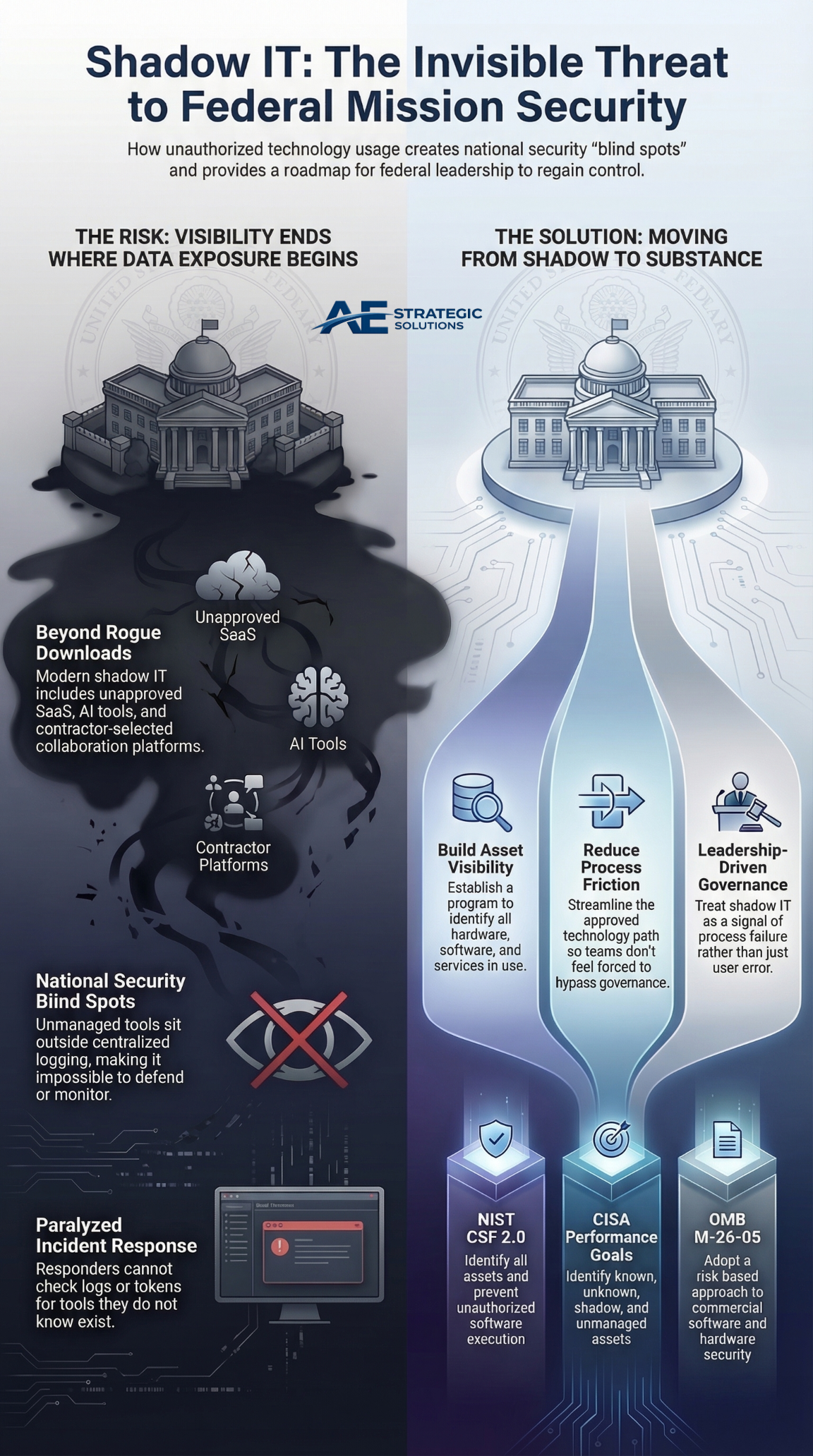
Table of Contents
- Why shadow IT matters in federal programs
- What shadow IT really looks like today
- Why unauthorized tools become compliance problems
- Data exposure starts where visibility ends
- Shadow IT weakens incident response and monitoring
- Off process decisions create operational drag
- What federal leaders should do now
- Why this matters for AE Strategic Solutions
- Summary
- References
Why shadow IT matters in federal programs
I see shadow IT as one of the most underestimated problems in federal cybersecurity. Most leaders do not wake up and approve risky technology behavior. It happens another way. A team needs to move faster. A program office wants a shortcut. A contractor uses a familiar app. A collaboration platform gets adopted before a security review. A cloud tool enters the workflow before governance catches up.
That pattern feels small in the moment. It is not small in effect.
NIST’s Cybersecurity Framework 2.0 says organizations need to understand their assets, including data, hardware, software, systems, and services, and it places governance, roles, policy, and oversight at the center of cybersecurity risk management. When federal programs lose track of what software and services are actually in use, they lose the foundation required to manage cyber risk responsibly.
What shadow IT really looks like today
It is not only rogue software downloads
When people hear shadow IT, they often picture a user installing an unapproved application on a laptop. That still happens, but the modern problem is broader.
In federal programs, shadow IT often looks like this:
Unapproved SaaS platforms
A team starts using an external file sharing, note taking, analytics, or workflow platform before the tool is reviewed for security, privacy, records, or FedRAMP alignment.
Contractor selected collaboration tools
A support team uses off contract messaging, storage, or ticketing tools because they are faster than the approved enterprise environment.
Unmanaged utilities and browser extensions
Small tools can still expose credentials, data, logs, and workflow patterns.
AI or automation tools adopted outside process
Teams experiment with third party AI tools or data processing services before legal, privacy, or security stakeholders assess how those tools handle federal data.
Duplicate systems created to avoid friction
Instead of fixing the approved path, an office creates a parallel path.
That matters because NIST’s software asset management work explicitly states that the capability’s focus is to manage risk posed by unmanaged or unauthorized software on a network. It also notes that devices with unauthorized software are likely to be vulnerable and can offer attackers opportunities for persistence or exploitation.
Why unauthorized tools become compliance problems
Shadow IT breaks the control model
Federal systems do not live on trust alone. They rely on documented architecture, approved configurations, inventories, access controls, monitoring, authorization boundaries, and accountable governance.
Once a team introduces an unmanaged app or off-process technology decision, several questions appear immediately:
- Is the tool in inventory?
- Has it been assessed for security and privacy risk?
- Does it store or process federal data?
- Does it move data outside an approved boundary?
- Is logging enabled and centrally visible?
- Is access tied to enterprise identity?
- Is the product under proper contract, licensing, and records management control?
Those questions are not paperwork. They are the difference between governed technology and untracked risk.
CISA’s Cybersecurity Performance Goals explicitly call for organizations to better identify known, unknown, shadow, and unmanaged assets so they can detect vulnerabilities and reduce exposure more quickly. NIST CSF 2.0 also includes a specific outcome that installation and execution of unauthorized software are prevented.
Federal programs still need disciplined software governance
OMB’s software licensing memo emphasized that agencies spend billions on software and need stronger management of software purchasing and use. More recent OMB guidance in January 2026 also stressed that agencies depend heavily on commercial hardware and software and must adopt a risk-based approach to software and hardware security. Together, those policies reinforce the same point: federal technology cannot be treated as a casual consumer choice.
Data exposure starts where visibility ends
Shadow IT becomes dangerous the moment federal data touches an unmanaged environment.
That exposure might involve:
- Controlled information stored in an unapproved SaaS
- Credentials reused across unsanctioned platforms
- Logs and exports sent into third-party tools
- Sensitive workflows processed outside the approved boundary
- Data retention practices that the agency never reviewed
The risk is not only theft. It is also loss of control. Once data moves into tools that are not in the system inventory, not connected to enterprise identity, and not covered by the expected monitoring stack, leaders lose confidence in where the data is, who accessed it, and what happened to it.
The CIO Council’s Cloud Operations Best Practices guide says agencies should establish a detailed inventory of application and technology assets and point them toward FedRAMP-authorized services for cloud use. That is the opposite of shadow adoption. It is governed by visibility.
Shadow IT weakens incident response and monitoring
You cannot defend what you do not know about
This is where shadow IT becomes a true operational problem. During a cyber incident, every unknown tool becomes a delay point.
If responders do not know an app exists, they do not know to check it for logs, tokens, exports, access pathways, retained data, or affected users. If an unsanctioned tool sits outside centralized logging, security teams lose evidence. If identity is local instead of federated, account review becomes slower and less reliable.
NIST’s incident response guidance says organizations should integrate incident response into broader cyber risk management activities to improve detection, response, and recovery efficiency. That depends on visibility. Unknown applications and unmanaged services work against that goal.
CISA’s 2024 advisory, based on federal civilian red team operations, also recommended centralized logging and tool-agnostic detection methods, which is a useful reminder that fragmented tooling and poor visibility create exploitable gaps.
Off process decisions create operational drag
Shadow IT often starts in the name of speed. Ironically, it usually creates the opposite over time.
It increases rework
Teams eventually have to unwind the tool, migrate data, or retrofit controls that should have been addressed up front.
It creates audit friction
If the tool was never reviewed, the program now has to explain why it was in use, what data it touched, and how risk was accepted.
It weakens architecture discipline
Parallel tools create duplicate workflows, confused ownership, and inconsistent records.
It strains trust between program and security teams
Security looks slow. Programs look careless. Neither side wins.
GAO’s work on federal software and asset management has repeatedly emphasized the need for accurate hardware and software information because, without it, agencies cannot identify unauthorized items in a timely way, and dashboards will not accurately reflect security posture. GAO also noted that unauthorized devices increase the risk of compromise. The same visibility logic applies to unauthorized software and services.
What federal leaders should do now
I do not think the answer is to lecture users about policy and hope behavior improves. Leaders need practical control.
Build a real asset visibility program
Know what hardware, software, services, and external dependencies are actually in use. NIST CSF 2.0 and NIST software asset management guidance both support this foundation.
Reduce friction in the approved path
If sanctioned tools take too long to request or deploy, people will route around the process.
Prevent unauthorized software execution where risk warrants
NIST CSF 2.0 explicitly calls for preventing the installation and execution of unauthorized software.
Tie identity, logging, and access to enterprise controls
Unmanaged apps should not be able to operate in the dark.
Review SaaS use through security, privacy, records, and acquisition lenses
A tool can be functional yet unacceptable for federal use.
Treat shadow IT as a leadership problem, not only a user problem
When shadow IT grows, it often signals process failure, governance gaps, or unmet mission needs.
Why this matters for AE Strategic Solutions
This is exactly the kind of gap AE Strategic Solutions is positioned to address. Shadow IT is rarely just a technical defect. It sits at the intersection of governance, cyber risk, program execution, compliance, and mission continuity. It requires a partner who understands how federal programs actually operate under pressure and how unauthorized technology decisions create outsized downstream risk.
The right response is not panic. It is disciplined visibility, smarter governance, and operationally realistic controls that keep programs moving without letting unmanaged tools rewrite the security boundary.
Summary
Shadow IT in federal programs is not a side issue. It is a security gap leaders cannot afford to ignore. Unauthorized apps, unmanaged SaaS, off-process technology decisions, and invisible workflows weaken compliance, expose data, complicate incident response, and distort the true security posture of the program. Federal leaders who want stronger cyber performance need more than policy language. They need asset visibility, governance discipline, lower process friction, and accountability for how technology enters the mission environment. That is how programs close the gap before it turns into an incident.
References
- Cybersecurity and Infrastructure Security Agency. (2023). Cybersecurity performance goals assessment report. U.S. Department of Homeland Security. https://www.cisa.gov/sites/default/files/2023-03/CISA_CPG_REPORT_v1.0.1_FINAL.pdf
- Cybersecurity and Infrastructure Security Agency. (2024, July 11). CISA red team’s operations against a federal civilian executive branch organization highlights the pervasive nature of unsecured identities. U.S. Department of Homeland Security. https://www.cisa.gov/news-events/cybersecurity-advisories/aa24-193a
- National Institute of Standards and Technology. (2018). Automation support for security control assessments: Software asset management capability definition, overview, and scope (NISTIR 8011 Vol. 3). U.S. Department of Commerce. https://csrc.nist.gov/pubs/ir/8011/v3/final
- National Institute of Standards and Technology. (2020). Security and privacy controls for information systems and organizations (SP 800 53 Rev. 5). U.S. Department of Commerce. https://csrc.nist.gov/pubs/sp/800/53/r5/final
- National Institute of Standards and Technology. (2024). The NIST Cybersecurity Framework (CSF) 2.0 (NIST CSWP 29). U.S. Department of Commerce. https://nvlpubs.nist.gov/nistpubs/CSWP/NIST.CSWP.29.pdf
- National Institute of Standards and Technology. (2025). Incident response recommendations and considerations for cyber risk management (SP 800 61 Rev. 3). U.S. Department of Commerce. https://csrc.nist.gov/pubs/sp/800/61/r3/final
- Office of Management and Budget. (2016, June 2). Category management policy 16 1: Improving the acquisition and management of common information technology: Software licensing (M 16 12). Executive Office of the President. https://www.whitehouse.gov/wp-content/uploads/legacy_drupal_files/omb/memoranda/2016/m-16-12_1.pdf
- Office of Management and Budget. (2026, January 23). Adopting a risk based approach to software and hardware security (M 26 05). Executive Office of the President. https://www.whitehouse.gov/wp-content/uploads/2026/01/M-26-05-Adopting-a-Risk-based-Approach-to-Software-and-Hardware-Security.pdf
- U.S. Chief Information Officers Council. (2023). Cloud operations best practices and resources guide. https://www.cio.gov/assets/resources/Cloud%20Operations%20Best%20Practices%20%26%20Resources%20Guide%20-%20October%202023.pdf
- U.S. Government Accountability Office. (2020). Cybersecurity: DHS and selected agencies need to address significant weaknesses in federal agencies’ implementation of continuous diagnostics and mitigation programs (GAO 20 598). https://www.gao.gov/assets/gao-20-598.pdf